
If you run a restaurant or love eating out, understanding GST on restaurant is very important in 2026. Whether it is dining at a café, ordering food online, or grabbing takeaway, GST affects the final bill you pay.
In simple words, GST is a tax added to your food bill. But the rules are not always easy to understand. Many restaurant owners and even customers get confused about rates, billing, and input tax credit.
This guide will help you understand everything about gst on restaurant in a very simple way. We will cover rates, rules, examples, and mistakes to avoid.
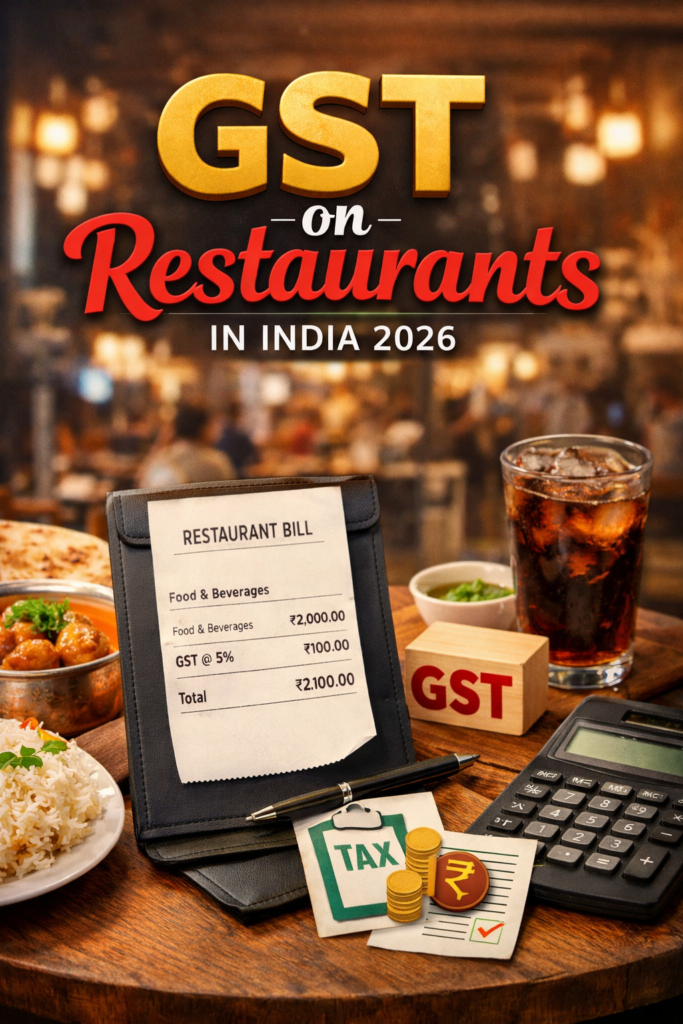
Confused about restaurant GST?
Here is what you need to know in 2026:
- Most restaurants charge just 5% GST
- No ITC at standard rate
- Luxury hotels charge 18% with ITC
- Swiggy & Zomato include extra GST on delivery
What is GST on Restaurant?
GST on restaurant is the tax applied to food and beverages served by restaurants in India. It replaced older taxes like VAT and service tax.
When you eat at a restaurant, GST is included in your bill. This applies to:
- Dine-in meals
- Takeaway orders
- Online food delivery
The concept of gst on food in restaurants ensures a single tax system across India.At the same time, gst on restaurant food varies depending on the type of restaurant and service.
Types of Restaurants under GST
Understanding categories is key to applying gst on restaurant correctly.
AC / Non-AC Restaurants
1. AC and Non-AC Restaurants
Earlier, AC and non-AC had different rates. Now, most fall under a standard category.
- Same GST rate applies
- No major difference now
Still, gst on food in restaurants depends more on business structure than AC status.
2. Fine Dining Restaurants
These are premium restaurants located in hotels or luxury settings.
- Higher pricing
- Sometimes higher GST rules apply
In such places, gst on restaurant food can include additional factors like hotel tariffs.
3. Cloud Kitchens
Cloud kitchens only serve online orders.
- No dine-in facility
- Operate through apps
For them, gst on restaurant works slightly differently because platforms may collect tax.
GST Rates on Restaurants in India 2026
Here is a clear table for understanding gst license on restaurant rates:
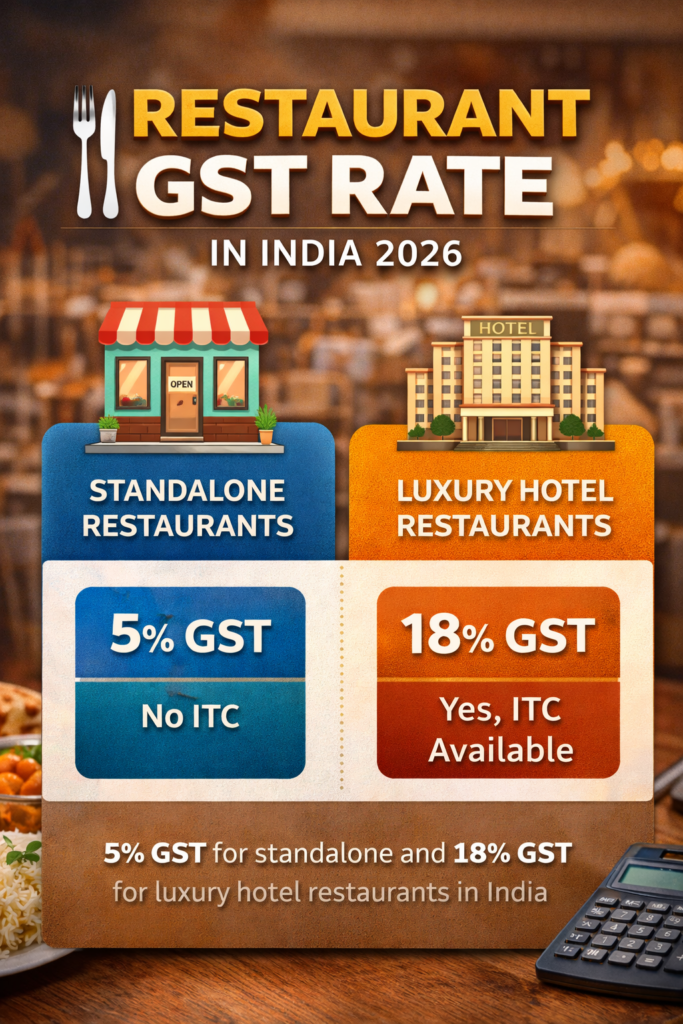
Key Points
- Most places charge 5% gst on food in restaurants
- Luxury hotels charge 18%
- ITC is not available in most cases
This means gst on restaurant food is simple for customers but can be tricky for business owners.
| Type of Restaurant | GST Rate | ITC Available |
| Regular restaurants | 5% | No |
| Restaurants in luxury hotels | 18% | Yes |
| Cloud kitchens | 5% | No |
| Food delivery via apps | 5% | No |
This table shows the restaurant GST rate in India clearly for 2026. Most small and medium restaurants stay at 5 percent, keeping bills pocket-friendly.
Remember, the 5 percent rate means the business absorbs input costs without credit. The 18 percent rate lets bigger venues recover taxes paid on purchases.
Input Tax Credit (ITC) Explained
ITC means you can claim tax paid on purchases.
But in most cases:
- Restaurants cannot claim ITC
- Only high-end hotels can claim
So for regular outlets, gst on restaurant becomes a cost.This also impacts pricing because gst on food in restaurants cannot be adjusted through ITC.
GST Rules for Restaurants in India
To comply with gst on food in restaurants, businesses must follow rules:
- Register under GST if turnover exceeds limit
- Issue proper GST bills
- File monthly or quarterly returns
- Display GSTIN on invoices
If rules are not followed, penalties may apply.
Also, correct billing ensures proper calculation of gst on restaurant food.
GST on Online Food Delivery (Apps)
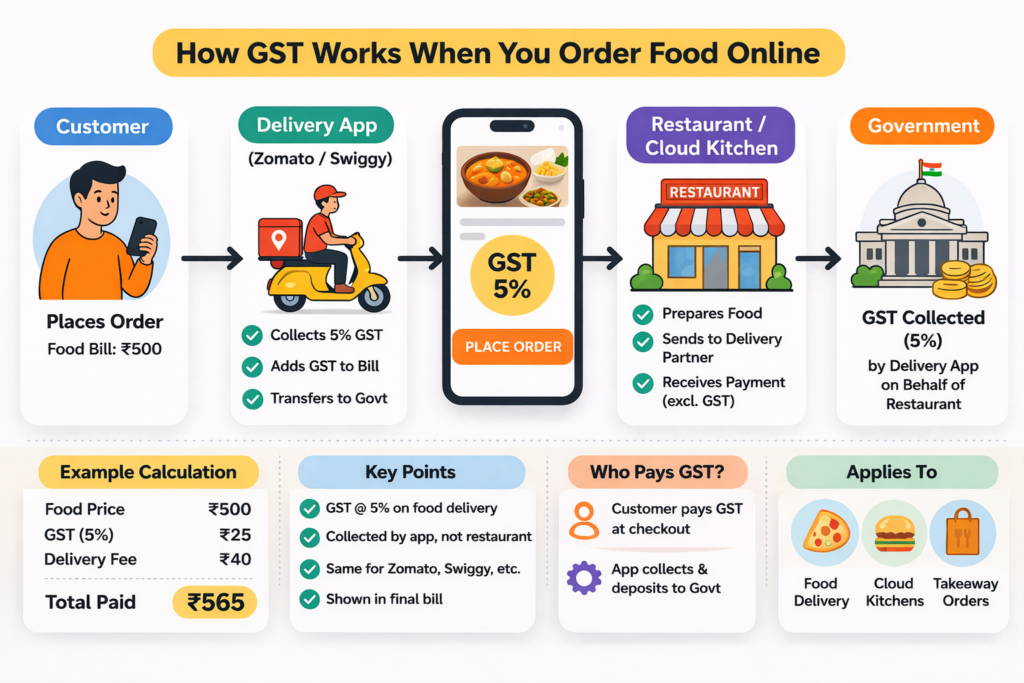
Platforms like Zomato and Swiggy collect GST.
- Apps collect 5% GST
- Restaurants do not charge separately
So, when you order online, gst on restaurant is handled by the platform.
This system simplifies gst on food in restaurants for cloud kitchens and small outlets.
GST Calculation Example (Practical Example)
Let us make GST on restaurant super easy with a real-life example. Imagine you and your family dine at a non-AC restaurant in Delhi. The bill before tax comes to Rs 2,000 for four meals and soft drinks.
Since it is a standalone restaurant, the restaurant GST rate in India is 5 percent. So GST amount equals Rs 100. Your final bill becomes Rs 2,100.
Now suppose the same order comes via Zomato. The restaurant charges 5 percent GST on the Rs 2,000 food value (Rs 100). The delivery partner adds Rs 60 fee with 18 percent GST (Rs 10.80). Total you pay: Rs 2,170.80.
For a cloud kitchen owner, the same Rs 2,000 order means they collect Rs 100 GST and deposit it. No ITC, so they plan purchases carefully to keep margins healthy.
This practical breakdown shows how gst on food in restaurants works in daily life, whether dine-in or takeaway.
GST Calculation Example
Let’s understand gst on restaurant with a simple example.
Example 1: Dine-in
- Food bill: ₹1000
- GST 5%: ₹50
- Total: ₹1050
Example 2: Luxury Hotel
- Food bill: ₹2000
- GST 18%: ₹360
- Total: ₹2360
This shows how gst on restaurant food varies.
Another takeaway example:
- Food: ₹500
- GST 5%: ₹25
- Total: ₹525
So, gst on food in restaurants is easy to calculate.
Common Mistakes Restaurant Owners Make
Many businesses struggle with gst on restaurant due to small mistakes.
Mistakes to avoid:
- Charging wrong GST rate
- Not issuing proper invoices
- Confusion in online vs offline GST
- Ignoring filing deadlines
Incorrect handling of gst on restaurant food can lead to penalties.
Also, misunderstanding gst on food in restaurants leads to pricing errors.
Benefits of GST for Restaurants
Even though it seems complex, gst on restaurant has benefits:
- Simplified tax system
- No multiple taxes
- Transparent billing
- Easy compliance
Customers also benefit because gst on food in restaurants is standardized.
Restaurants can focus on business rather than managing multiple taxes.
FAQs
Most restaurants charge 5% gst on food in restaurants
No, except luxury hotels. This affects gst on restaurant food.
Yes, apps include gst on food in restaurants in the final price.
Because of their classification, gst on restaurant is higher.
Yes, 5% gst on food in restaurants applies.
Apps collect gst on food in restaurants on behalf of restaurants.
Conclusion
Understanding gst on restaurant is essential for both customers and business owners in 2026.
In most cases:
- Standard rate is 5%
- No ITC for regular restaurants
- Online platforms handle GST
By learning the basics of gst on food in restaurants and gst on restaurant food, you can avoid confusion and make better financial decisions.
If you run a restaurant, always follow GST rules carefully. Proper billing and compliance will help your business grow smoothly.